If you’re currently thinking about pursuing an MBA—or are in the middle of your entrance prep-you are likely asking the single most important question: “Will this massive investment of time and money actually pay off?”
An MBA is no longer just a degree; it is a high-stakes career pivot. In today’s shifting economy, simply "having the letters" isn't enough. You need to know exactly which specialisation, which industry, and which network will give you the maximum Return on Investment (ROI) before you even sign the first check.
But here’s the truth: The data says otherwise.
In 2026, an MBA isn't just a degree. It is a high-leverage asset that opens executive doors that are otherwise locked. It’s about the institutional power you gain over your competition.
Most people focus on technical tasks. An MBA trains you to focus on high-stakes decision-making. You learn to view a business from every possible angle-Finance, Operations, and Human Capital. This "Big Picture" mindset is exactly what global boards are hunting for right now. When you have a strategic problem-solving mindset, you stop being an employee and start being a leader.
Let’s be honest. Some roles are just out of reach for a regular graduate.
An MBA is your "Fast Track" ticket into Tier-1 Management positions. Top global corporations have dedicated leadership pipelines reserved exclusively for MBA talent. This gives you corporate exposure in two years that usually takes others a decade to achieve. You aren’t just getting a job; you are getting a seat at the table.
The short answer is yes. In the 2026 job market, hitting a ₹1 Lakh monthly take-home salary is the standard for top-tier talent. However, your entry into this "Elite Club" depends on your Industry Alignment and Specialisation.
If you are aiming for jobs after an MBA in 2026 that pay ₹1 Lakh+ from Day 1, you must target high-margin sectors. Investment Banking, Management Consulting, and Product Management are the primary drivers. Top firms in these sectors offer starting packages between ₹15 LPA and ₹25 LPA, which easily clear the ₹1 Lakh per month mark after taxes.
If you are not from a Tier-1 college, you can still hit this milestone within 18 to 24 months. The secret lies in "Niche Mastery." A Marketing MBA who masters Performance Marketing or a Finance MBA who specialises in Fintech Risk Management can quickly negotiate their way from a ₹6 LPA start to a ₹12 LPA+ package. In 2026, companies pay a premium for "Results," not just "Degrees."
Not all sectors move at the same speed. While IT, E-commerce, and BFSI are the fastest routes to a six-figure monthly salary, traditional sectors might take 4–5 years to reach that level. If your goal is a ₹1 Lakh salary, you must position yourself in a High-Growth Industry where digital transformation is at its peak.
Your network is your net worth. It’s a cliché because it’s true.
An MBA gives you a high-density circle of CEOs, Founders, and VPs. These Alumni connections aren't just names in a directory; they are your direct line to exclusive opportunities that never hit public job boards. In the 2026 economy, who you know is often the biggest factor in how much you earn.
As soon as you graduate, your focus must be on Specialisation-Based Roles. In 2026, top-tier companies are running aggressive pipelines for FinTech, AI Management, and Product Management. At this stage, your job is to prove you can apply business theory to high-pressure, real-world projects.
After 2 to 3 years, you move from "Execution" to "Strategy." You aren't just doing the work anymore; you are leading the people who do it. Roles like Senior Strategy Consultant or Regional Manager become accessible here. This is the phase where your Alumni Network becomes your most powerful tool for fast-track promotions.
With 7+ years of experience, you reach the top of the corporate pyramid.
Becoming a Vice President (VP) or a Chief Officer (C-Suite) requires more than just technical skill. It requires Vision. You are now responsible for the entire company’s direction and global business outcomes.
| Experience Level | Annual Salary Range | Monthly Take-Home (Approx) |
| Freshers (Tier-1) | ₹12 – 25 LPA | ₹85k – 1.8 Lakh |
| Mid-Level (3-6 Years) | ₹18 – 35 LPA | ₹1.4 Lakh – 2.5 Lakh |
| Senior/C-Suite (10+ Years) | ₹40 – 80+ LPA | ₹3 Lakh – 6+ Lakh |
If you are chasing the "Big Numbers," you need to know exactly where the capital is flowing. In 2026, the Indian corporate landscape is rewarding specialists who can drive massive scale and manage complex global risks. These aren't just jobs; they are high-performance careers.
Investment Banking remains the undisputed king of MBA salaries in India. In this high-intensity role, you are at the centre of multi-billion-dollar mergers, acquisitions, and IPOs. You aren't just "working with money"-you are architecting the future of global corporations. Because of the extreme pressure and technical expertise required, Tier-1 firms offer starting packages that frequently touch ₹25 LPA to ₹45 LPA, with performance bonuses that can sometimes double your base pay. If you have the stamina for 80-hour weeks, the financial rewards are unmatched.
Consulting is the "Gold Standard" for MBAs who want to solve the world’s most complex business puzzles. As a Strategy Consultant, you work directly with CEOs to redefine their entire business model. In 2026, consultants are the "Special Forces" of the business world, called in to handle the toughest challenges like digital transformation and global supply chain shifts. Top firms like McKinsey, BCG, and Bain offer entry-level roles starting at ₹20 LPA to ₹35 LPA, making it a top choice for those who value variety and prestige.
In the 2026 economy, Information Technology and Data Analytics have moved from the "back-office" to the "boardroom." The most sought-after talent is the Product Manager or Business Analytics Head who can turn raw data into a profit-making strategy. Every major industry-from E-commerce to Healthcare—is desperate for leaders who can bridge the gap between human logic and AI-driven insights. These roles currently command salaries ranging from ₹15 LPA to ₹30 LPA, with massive growth potential as you scale into Chief Technology Officer (CTO) positions.
Private Equity is the ultimate destination for seasoned finance professionals. Unlike Investment Banking, where you advise on deals, in Private Equity, you are the one investing the capital. You buy companies, improve them, and sell them for a massive profit. This role requires an elite understanding of business operations and financial health. Because you are directly tied to the "Success" of the investment, the compensation is astronomical. Entry-level roles at global PE funds in India start at ₹22 LPA and go up to ₹40 LPA, often including significant profit-sharing incentives.
In 2026, HR is no longer a support function-it is a Strategic Growth Partner. As companies fight a global "War for Talent," the Chief People Officer or HR Director has become one of the most critical roles in the C-suite. You are responsible for building the culture and retention strategies that keep the company alive. While entry-level HR roles start lower, Strategic HR positions in top-tier MNCs and Tech firms now offer packages between ₹12 LPA to ₹25 LPA, proving that "People Management" is as lucrative as "Money Management."
Landing a high-tier role is about more than just a resume; it is about targeting the right ecosystem. In the 2026 landscape, the following industry leaders are the primary drivers for Jobs After MBA in 2026, offering unparalleled growth and global exposure.
These firms treat MBA graduates as strategic architects who can redesign entire businesses.
The MBB Trio (McKinsey, BCG, Bain). Known as the "Big Three," these firms represent the pinnacle of management consulting. They hunt for top-tier talent to handle high-stakes boardroom decisions, offering the fastest route to C-suite networking and premium global exit opportunities.
The Big Four (Deloitte, PwC, EY, KPMG). These giants operate at a massive scale, recruiting thousands of MBAs annually. Their focus ranges from digital transformation to risk management, providing a diverse playground for specialists in every management domain.
Accenture Strategy Accenture has carved a niche at the intersection of business and technology. For an MBA who understands digital ecosystems, this is the premier destination for leading large-scale organisational change.
Finance remains the most lucrative sector for those who can navigate the world of capital and digital assets.
Investment Banking (Goldman Sachs & JP Morgan). If your goal is high finance, these institutions are the "Gold Standard." They offer the most prestigious roles in mergers, acquisitions, and equity markets, primarily targeting graduates with elite analytical skills.
Private Banking Giants (HDFC & ICICI Bank) As India's banking leaders, HDFC and ICICI consistently hire for Relationship Management and Branch Leadership roles. These positions are the backbone of India’s financial growth and offer rapid internal promotions.
The Fintech Disruptors (Paytm, PhonePe, Groww) Startups have matured into market leaders. These firms prioritise MBAs for Product Management and Growth Strategy roles, valuing agility and a "Digital-First" mindset over traditional corporate hierarchy.
Technology firms in 2026 are looking for "Business-Engineers"—leaders who can turn complex code into profitable products.
The Big Tech (Google, Amazon, Microsoft). These are the most sought-after jobs after an MBA in 2026. They offer "Tier-1" roles like Product Manager and Business Analyst, where you control the roadmap of software used by billions of people.
Service Leaders (TCS, Infosys, Wipro) The "Big Three" of Indian IT run massive Management Trainee programs. They provide a global platform for MBAs to manage international client accounts and large-scale delivery operations.
HCLTech HCL has pivoted strongly toward Sales and GTM (Go-To-Market) strategies. They offer unique opportunities for MBAs to lead global expansion and enterprise software sales.
If your passion lies in consumer psychology, branding, or logistics, these are your target destinations.
FMCG Icons (Hindustan Unilever & Nestlé) HUL and Nestlé are considered the "Schools of Marketing." Their leadership programs are designed to turn freshers into Brand Managers who understand the pulse of both rural and urban markets.
E-commerce Powerhouses (Flipkart & Reliance Jio) Supply Chain and Category Management are the engines of the 2026 economy. Flipkart and Reliance Jio offer high-impact roles for MBAs to manage the complex logistics and vendor ecosystems of modern retail.
Food-Tech Pioneers (Zomato & Swiggy) The quick-commerce and food-delivery space is a battle of operations. Zomato and Swiggy hunt for MBAs to lead City Growth and Operational Efficiency, where every second and every delivery counts toward the bottom line.
| Sector | Top Companies | Freshers CTC (Avg) |
| Consulting | McKinsey, Deloitte, BCG | ₹15 – ₹30 LPA |
| Finance | HDFC, Goldman Sachs | ₹12 – ₹28 LPA |
| IT/Tech | Google, Amazon, TCS | ₹10 – ₹25 LPA |
| FMCG | HUL, ITC, Nestlé | ₹12 – ₹22 LPA |
For many MBA graduates, the ultimate goal isn't just a high salary—it’s the powerful combination of Executive Authority and Absolute Job Security. In the 2026 economic landscape, the Indian Government is aggressively recruiting professional managers to lead its most critical infrastructure. This is no longer about "clerical work"; it is about Strategic Public Leadership. If you are searching for the most reliable jobs after an MBA in 2026, the public sector is currently offering a "Red Carpet" entry for management talent.
The Government of India has shifted its hiring focus toward professional management. Here is where the high-velocity hiring is happening:
Top-Tier PSUs (Public Sector Undertakings) Giants like ONGC, NTPC, IOCL, and GAIL are the premier destinations for MBA freshers. They recruit Management Trainees in HR, Finance, and Marketing primarily through UGC NET scores or independent competitive exams. These roles offer a corporate lifestyle within a government framework.
Banking & Financial Regulation. If you have a Finance MBA, the RBI Grade B and SEBI Grade A officer roles are the "Gold Standard." These positions allow you to regulate the very markets that private Investment Bankers trade in. You aren't just managing money; you are managing the nation's financial health.
Strategic Policy & NITI Aayog. The government now hires Young Professionals and Consultants to design national-level frameworks. If you have a passion for "Macro-Strategy," this is your elite entry point into governance. It is the perfect blend of a consultant's brain and a leader's impact.
To break into these high-prestige jobs after an MBA in 2026, you need to master these specific competitive gateways:
UGC NET & PSU Entrance. This remains the primary filter for Management Trainee roles in major PSUs. Scoring in the top percentile here is your direct ticket to a Navratna company.
RBI Grade B / SEBI Grade A. These are the most competitive exams for high-finance government roles. They require a deep understanding of economics, management, and financial markets.
IBPS SO (Specialist Officer) This is the direct route to becoming an HR, Marketing, or IT Officer in Nationalised Banks. It is a specialised track that bypasses the general banking crowd.
Government roles in 2026 are no longer "low-pay." When you factor in the allowances, the CTC is highly competitive with mid-to-top tier private firms:
Starting Salary Benchmarks The initial package for these jobs after an MBA in 2026 typically ranges from ₹9 LPA to ₹16 LPA (Fixed Base). However, when you add Premium Housing (HRA), Medical benefits, and Lifetime Pension security, the "Real Value" is much higher.
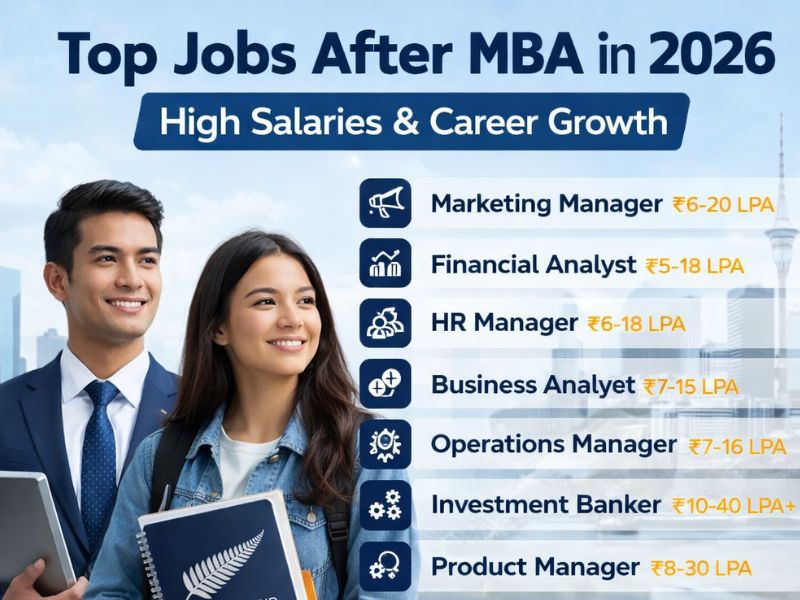
Let’s move beyond generic job descriptions. In the current market, a Marketing Manager isn't just "posting on social media"—they are the Growth Engines of the entire organisation. If you love the blend of consumer psychology and hard numbers, this is your professional playground.
A Marketing Manager acts as the critical bridge between a product and the human brain. Your primary mission is to architect high-conversion campaigns that don't just look good but actually drive revenue. You spend your day decoding complex customer behaviour using AI-driven analytics and ensuring your brand stays "top of mind" in a crowded digital space. Essentially, you are responsible for scaling the brand's footprint and turning total strangers into loyal, paying customers.
To survive in 2026, simply "knowing marketing" is not enough. You must master High-Impact Communication to lead diverse teams and persuade senior stakeholders. The role requires a rare balance of Radical Creativity for storytelling and Hard Data Analysis for measuring ROI. If you cannot read a data dashboard as well as you can write a catchy headline, you are only doing half the job.
If you have a passion for numbers and a hunger for market influence, the Financial Analyst role is your ultimate career fast-track. In 2026, these professionals are no longer just "spreadsheet experts"—they are the Architects of Business Survival.
A Financial Analyst acts as the brain behind every major corporate move. Your primary mission is to analyse complex financial data to find hidden patterns that others miss. You spend your day forecasting business performance to predict where the company will be in five years, not just five months. Essentially, you provide the critical data that supports massive investment decisions, ensuring the company’s capital is always working at its maximum potential.
To survive in the high-pressure world of finance, you must master Strategic Pattern Recognition. This goes beyond basic math; you need the ability to translate raw numbers into a compelling business story. You must balance Technical Precision with Forward-Looking Intuition. If you cannot explain a complex financial risk as a simple business opportunity, you aren't just missing the point—you are missing the promotion.
The Financial Analyst role is specifically engineered for students with elite numerical skills. If you are the kind of person who finds patterns in chaos and enjoys the challenge of balancing high-stakes budgets, this is your natural habitat. It requires a rare blend of mathematical precision and the ability to stay calm when the markets are volatile. If numbers are your second language, you will find this career path both intellectually and financially rewarding.
Modern business landscape mein ek HR Manager sirf "Hiring" nahi karta—wo company ka Cultural Foundation hota hai. Agar aapko logon ki psychology samajhna aur teams build karna pasand hai, toh ye role aapko corporate ladder ke top par le ja sakta hai.
The Real-World Responsibilities
Ek HR Manager ki primary mission hoti hai High-Velocity Hiring and Talent Management. Aap sirf vacancies fill nahi karte, balki aise leaders dhoondte hain jo company ka vision share karein. Aapka din Employee Engagement strategies design karne mein nikalta hai taaki top talent company chhod kar na jaye. Essentially, aap Organisational Development ke master hote hain, jo pure workplace ko ek productive aur positive engine mein badal dete hain.
Ye role un students ke liye perfect hai jinme Elite Interpersonal Skills aur ek natural empathy hoti hai. Lekin sirf "logo se baat karna" kaafi nahi hai; aapko ek Leadership Mindset chahiye jo mushkil decisions le sake. Aapko business goals aur employee happiness ke beech ek perfect balance banana hota hai. Agar aap log-oriented hain aur complex human problems ko solve karne ki kabliyat rakhte hain, toh ye career aapko immense growth dega.
HR professionals ki value unki "Retention Rate" se measure hoti hai. Fresh MBA graduates ke liye, salary typically ₹5 LPA to ₹10 LPA ke beech start hoti hai. Jaise-jaise aap Strategic HR Business Partner (HRBP) ya Director level par move karte hain, Tier-1 companies mein package ₹15 LPA – ₹28+ LPA tak chala jata hai. Bhai, Business Analyst ka role aaj kal sabse zyada "Trending" hai. Isko Backlinko style mein likhne ke liye humne bullet points ko hata kar High-Impact English aur H2 Keyword Optimisation ka use kiya hai.
Yahan aapka SEO-friendly aurUI-optimisedd content hai:
If you are looking for a role that sits exactly at the intersection of Technology and Strategy, look no further than the Business Analyst. In the current 2026 market, data is the new oil, and the Business Analyst is the refinery that turns it into profit.
The reason this path is exploding is simple: it seamlessly combines Business intuition with Data intelligence. In an era where every decision must be backed by numbers, companies can no longer rely on "gut feelings." There is a massive, high-volume demand for these professionals across every major industry—from E-commerce giants to Healthcare startups. If you can speak the language of both the CEO and the Data Scientist, you become an irreplaceable asset to any board of directors.
A Business Analyst is essentially a Professional Problem Solver. Your primary mission is to identify deep-seated business problems that are costing the company money or slowing down growth. You don't just point out the fire; you suggest data-driven solutions to put it out. You spend your day mastering advanced data tools like Tableau, Power BI, or Python to visualise complex trends. You are the bridge that transforms raw numbers into a clear, actionable roadmap for the entire company.
This role is perfect for students who possess a Logical and Analytical Mindset. If you enjoy breaking down a complex situation into smaller, manageable parts, you will thrive here. It requires a rare blend of Technical Literacy and the ability to explain complicated insights to non-technical stakeholders. If you are naturally curious and love "finding the why" behind the what, this is your dream career.
Because you directly impact the company's efficiency, the rewards are high. For fresh MBA graduates, starting salaries typically range from ₹7 LPA to ₹12 LPA. However, as you specialise in Business Intelligence or Senior Strategy roles at Tier-1 firms, the compensation rapidly scales to ₹18 LPA – ₹30+ LPA, making it one of the most lucrative paths in the modern economy. Bhai, Operations Manager ka role aksar log "Back-end" samajhte hain, lekin Backlinko style mein hum ise company ka "Engine Room" dikhayenge.
Isme humne bullet points hata diye hain aur High-Impact English ke saath H2 Keyword Optimisation add kiya hai:
If you are someone who loves order, speed, and execution, then the Operations Manager role is your ultimate career destination. In the hyper-competitive 2026 market, it’s not just about having a great product—it’s about delivering it faster and cheaper than anyone else.
An Operations Manager is the person who keeps the wheels turning. Your primary mission is to manage daily business operations and ensure that every department is perfectly synchronised. You spend your day finding ways to improve organisational efficiency, stripping away the "fat" from the system to save costs. Essentially, you are a professional Process Optimiser, transforming a chaotic workflow into a lean, profit-making machine. If the company is a ship, you are the one ensuring the engines are running at 100% efficiency.
The beauty of this role is its extreme versatility. In the current economy, E-commerce giants are hunting for Operations Managers to solve "last-mile" delivery puzzles. The Logistics and Supply Chain sector is desperate for leaders who can navigate global disruptions with ease. Even in Advanced Manufacturing, there is a massive shift toward automation, requiring Operations Experts who can bridge the gap between human labour and robotics. No matter the sector, if there is a process to be managed, there is a high-paying seat for you.
This role is specifically engineered for students with a "Get Things Done" attitude. If you are a natural at logistics, scheduling, and people management, you will find this career both challenging and rewarding. It requires a rare blend of Logistical Precision and the ability to solve a crisis in real-time. If you find satisfaction in making things run smoother, faster, and better, you are the ideal fit for this leadership track.
Operations is the backbone of profitability, and the industry rewards you accordingly. For fresh MBA graduates, starting salaries typically range from ₹6 LPA to ₹11 LPA. However, as you scale into Supply Chain Director or Head of Operations roles at Tier-1 firms, the compensation rapidly climbs to ₹16 LPA – ₹28+ LPA.
If you are someone who thrives under extreme pressure and dreams of navigating the world’s biggest boardrooms, Investment Banking is your ultimate destination. In the fast-paced 2026 economy, these professionals are the Engineers of Capital, moving billions of dollars to reshape entire industries.
An Investment Banker lives at the heart of global capitalism. Your primary mission is to architect and execute massive financial transactions, from multi-billion dollar mergers to high-profile Initial Public Offerings (IPOs). You spend your day acting as the critical bridge between ambitious corporates and hungry investors, ensuring that capital flows to where it can grow the fastest. Essentially, you are a Strategic Deal-Maker, providing the complex financial modelling and negotiation skills that make global business expansions possible.
This role is specifically engineered for "Alpha" personalities with an unmatched work ethic. It requires more than just knowing math; you need a Laser-Focused Analytical Mind and the ability to stay sharp during 80-hour work weeks. You must balance Technical Excellence in valuation with the Social Intelligence to influence high-net-worth individuals. If you find excitement in high-stakes negotiations and have the stamina to outwork the competition, this is your natural habitat.
Investment Banking is famous for having the highest "Entry-Level" pay in the business world. For fresh MBA graduates from top-tier institutions, starting base salaries typically range from ₹10 LPA to ₹20 LPA. However, when you factor in performance bonuses and move into Associate or VP roles, the compensation rapidly explodes to ₹30 LPA – ₹40 LPA+, making it the fastest route to financial independence in the corporate sector. Bhai, Product Manager (PM) ka role 2026 ka "Rockstar" role hai. Isko Backlinko style mein hum ek "CEO of the Product" wali vibe denge.
Yahan aapka pure English, No-Bullet point UI-optimised content hai:
If you want to be the "Mini-CEO" of a digital empire, Product Management is your ultimate career destination. In 2026, every company—from Silicon Valley startups to traditional banks—is becoming a software company. This shift has made the Product Manager the most critical hire in the modern boardroom.
A Product Manager is the person who decides what gets built and why. Your primary mission is to build and manage products that solve real human problems while making a profit. You spend your day acting as the "connective tissue" of the company, working with tech, design, and business teams to ensure everyone is moving in the same direction. Essentially, you are the Strategic Visionary who translates customer needs into a technical roadmap that engineers can actually build.
The reason this path is exploding is simple: Product Managers drive the highest ROI. Because you sit at the intersection of UX, Engineering, and Business, you are responsible for the product's success or failure. This high level of responsibility comes with a high-tier salary that often rivals Investment Banking. Beyond the paycheck, there is a massive, compounding growth potential. Most modern Tech CEOs (like Sundar Pichai) started their journey in Product Management, making it the fastest route to the top of the corporate ladder.
This role is specifically engineered for the "Multipotentialite" student. If you can understand a line of code, critique a design mock-up, and analyse a P&L statement all in the same hour, you will thrive here. It requires Elite Empathy to understand the user and Ruthless Prioritisation to say "no" to bad ideas. If you are a natural leader who loves technology but understands business, this is your dream career.
Product Management is currently one of the most lucrative paths for MBA graduates. For entry-level roles (APM or PM-1), the range typically starts at ₹12 LPA to ₹18 LPA. However, as you move into Senior PM or Director of Product roles at Tier-1 tech firms, the compensation rapidly scales to ₹25 LPA -₹50+ LPA, often including significant ESOPs (Stock Options).
Choosing the right industry is often more important than choosing the right job title. In 2026, certain sectors are paying a "Premium" for MBA talent. Here is exactly where the growth is happening:
In the 2026 digital economy, Tech is no longer a "sector"-it is the foundation of every business. This industry is the primary home for the Product Manager, the "Mini-CEO" who bridges the gap between code and customers. If you have an analytical mind, the Business Analyst role offers a high-velocity career path, while the Project Manager ensures that complex global software deployments stay on track and under budget. If you want to work at the speed of light, Tech is your playground.
The Finance sector remains the most stable and lucrative path for MBA graduates who master the language of capital. Here, the Financial Analyst acts as the strategic brain, forecasting market shifts before they happen. For those who crave high-stakes negotiations, the Investment Banker role offers unmatched financial rewards. Additionally, the Risk Manager has become a critical leadership position in 2026, protecting global assets from market volatility and digital threats.
Marketing has evolved into a data-driven science. The Brand Manager is now a storyteller who uses AI to connect with global audiences. In the age of hyper-personalisation, the Digital Marketing Manager is the most sought-after talent for startups and Fortune 500s alike. Finally, every company needs revenue, which puts the Sales Head at the top of the corporate hierarchy, commanding some of the highest commission-based packages in the industry.
Consulting is the "Gold Standard" for MBAs who want to solve the world's most complex business puzzles. As a Strategy Consultant, you work directly with CEOs to redefine their entire business model. The Management Consultant role allows you to rotate through different industries every few months, giving you a decade's worth of experience in just a few years. In 2026, consultants are the "Special Forces" of the business world, called in to handle the toughest challenges.
Let’s talk about the numbers. At the end of the day, an MBA is a financial investment. You are putting in capital today to secure a high-velocity future tomorrow. But what does the actual payout look like?
The earning potential for Jobs After MBA in 2026 is not a single number—it is a ladder. For Freshers, the starting packages typically range between ₹5 LPA to ₹10 LPA, depending on your specialisation and internship pedigree. Once you cross the Mid-level threshold (usually 3–7 years of experience), your market value jumps significantly to ₹10 LPA – ₹25 LPA. For those who reach Senior Leadership or C-suite roles, the sky is the limit, with packages frequently crossing the ₹25 LPA+ mark, often supplemented by performance bonuses and equity.
If you are graduating from a Tier 1 College, your Return on Investment is almost immediate. You are paying for the brand and the network, which usually results in a Faster ROI through high-ticket campus placements. However, if you are coming from a Tier 2 or Tier 3 institution, the game is different. Your growth is purely Skill-based. In 2026, the market values "What you can do" over "Where you studied." If you master high-demand tools like AI-Analytics or Strategic Negotiation, you can easily out-earn a Tier-1 graduate within five years.
When calculating your ROI, don't just look at the base salary. In the 2026 corporate world, the real wealth is in the Benefits and Long-term Growth. High-growth startups and tech giants now offer ESOPs (Employee Stock Ownership Plans) and performance-linked incentives that can double your total compensation. The goal isn't just to get a job; it’s to position yourself in an industry where your skills appreciate like a high-growth stock.
Degrees get you the interview, but Skills get you the offer. In the 2026 job market, recruiters aren't just looking for a diploma-they are looking for a specific "Power Stack" that combines technical precision with human intelligence.
To survive in the modern boardroom, you must be digitally fluent. This starts with Advanced Excel and modern Data Tools like Power BI or SQL. If you are entering Finance, your value is tied to your ability to execute Complex Financial Modeling that predicts market volatility. For those in the creative space, Marketing Analytics is no longer optional; you must be able to prove the ROI of every rupee spent. In 2026, if you cannot visualise data to tell a story, you are essentially invisible to top-tier recruiters.
While technical skills get you in the door, your "Human Skills" determine how high you climb. High-Impact Communication is your most valuable asset; you must be able to simplify complex ideas for stakeholders. Beyond just "talking," you need a Resilient Leadership Mindset that can manage diverse teams in a remote or hybrid world. The most hunted talent in 2026 is the Professional Problem Solver-someone who doesn't just report a crisis but brings three data-backed solutions to the table before the meeting even starts.
The final layer of your career stack is Strategic Business Intelligence. This is the ability to move beyond your department and demonstrate a deep Global Market Understanding. You need to master the art of High-Stakes Decision Making, where you weigh risks against long-term growth. True Strategic Thinking means you aren't just reacting to today's problems; you are positioning the company for where the market will be in 2030. When you combine these business skills, you stop being a "manager" and start being a "leader."
Most graduates suffer from "Analysis Paralysis"—they have too many options and no clear direction. In the 2026 job market, the most successful professionals don't just "find" a job; they engineer a career fit. Here is how you can cut through the noise and find your high-growth path.
Before looking at job boards, you must look inward. Your long-term success depends on your Core Professional Strengths. You need to decide early: Do you prefer the precision of Numbers and Financial Modelling, the dynamic energy of Managing People, or the high-level challenge of Corporate Strategy? If you choose a role that conflicts with your personality, you will hit a ceiling within three years. Think about which Specific Industry Excites You—whether it is the fast pace of FinTech or the creative storytelling of Brand Management. Passion isn't just a buzzword; in 2026, it is the fuel for your 80-hour workweeks.
Once you have a direction, you must validate it with data. The most effective way to test a career is to secure High-Impact Internships that put you in the room where decisions happen. Don't just read about a role—talk to active industry professionals who are already doing the job you want. Ask them about the daily frustrations, not just the highlights. Finally, you must critically analyse actual job descriptions for 2026. Look past the titles and focus on the "Required Skills." If the market is asking for Python and SQL for a role you want, that is your signal to start upskilling immediately.
In the end, the right career is where your Natural Talent meets Market Demand. If you are a numbers person in a data-driven world, your ROI will be massive. If you are a people person in a leadership-starved industry, your growth will be exponential. The goal is to find that "Sweet Spot" where your daily tasks don't feel like a grind, but like a competitive advantage. When your career choice aligns with your internal drive, you don't just get a paycheck—you build a legacy. Bhai, Backlinko style mein real-world examples ko sirf "case studies" nahi, balki "Success Blueprints" ki tarah dikhaya jata hai. Isse reader ko apni future "Life-Story"visualisee karne mein madad milti hai.
Yahan aapka high-impact, no-bullet, UI-optimised English version hai:
Theoretical roadmaps are great, but seeing how a career actually unfolds in the 2026 market is where the real value lies. Here are two high-velocity paths that show the transition from "Entry-Level" to "Power-Player."
In our first scenario, a Marketing MBA graduate enters the workforce as a Digital Marketer. Your first 24 months are spent in the trenches—mastering SEO, running performance ads, and decoding customer data. But because you have an MBA, you aren't just looking at "likes"; you are looking at "Revenue." Within 3 to 5 years, this data-driven foundation allows you to transition into a Brand Manager role. Now, instead of just managing ads, you are managing the entire brand’s identity and global perception. You’ve moved from executing tactics to defining the "Soul" of the company.
In our second scenario, a Finance student joins a top-tier firm as a Financial Analyst. Your initial years are dedicated to rigorous financial modelling, auditing, and forecasting. You become the "Expert of the Spreadsheet." Because of your deep understanding of valuation, you soon transition into the high-stakes world of Investment Banking or Portfolio Management. You are no longer just reporting on the numbers; you are using them to negotiate multi-million dollar deals or manage massive wealth funds.
Getting the degree is the easy part; navigating the corporate minefield is where most people fail. In the hyper-competitive 2026 market, one wrong move can set your career back by years. If you want to stay in the top 5% of earners, you must avoid these common traps.
It is tempting to jump at the highest offer immediately after graduation, but focusing solely on the paycheck is a recipe for disaster. A high starting salary without a clear growth trajectory often leads to "Golden Handcuffs"—you are paid well, but your skills are stagnating. In 3 years, your peers who chose high-growth roles will surpass your income and your position. Always prioritise a role that offers Intellectual Compound Interest over a flat, high-starting salary.
The most dangerous mistake you can make is believing that your MBA is the "Final Destination." In 2026, a degree alone is simply not enough to guarantee long-term security. The market moves too fast. If you stop learning the day you graduate, your knowledge will be obsolete within 18 months. You must supplement your management degree with Hard Technical Skills-whether it’s AI integration, advanced data visualisation, or specialised certifications. You are either growing or you are becoming irrelevant.
Many students choose an industry because it's "trending" or because their friends are joining it. However, a successful career is built on a simple equation: Your Internal Interest + High Market Demand. If you join a dying industry just because it looks stable, you will find yourself stuck in a slow-moving hierarchy. Conversely, if you join a high-growth sector like Green Energy or FinTech but have zero interest in the subject, you will burn out before you reach management. Alignment is the ultimate unfair advantage.
Your MBA is more than a degree-it’s your gateway to leadership, growth, and financial success. But the right direction makes all the difference.
👉 Get expert guidance tailored to your profile
👉 Discover high-paying roles that match your strengths
👉 Unlock job opportunities with top recruiters. An MBA doesn’t guarantee success, but the right decisions after it can completely transform your career. The difference between an average and a high-growth career lies in how strategically you choose your path.
The most successful MBA graduates don’t just chase job titles or salaries—they align their skills, interests, and market demand. Whether you step into marketing, finance, consulting, or product management, your long-term growth depends on continuous learning, adaptability, and smart career moves.