
If you have a passion for creativity combined with strong technical problem-solving skills, then pursuing an M.Tech in Design Engineering can be a highly rewarding career choice. This program is ideal for engineering graduates who aspire to specialise, innovate, and step into high-growth roles across design, product development, and advanced engineering domains.
In this guide, you will gain a complete understanding of the course- from its structure and learning approach to career opportunities- helping you make a confident and informed decision about your future.
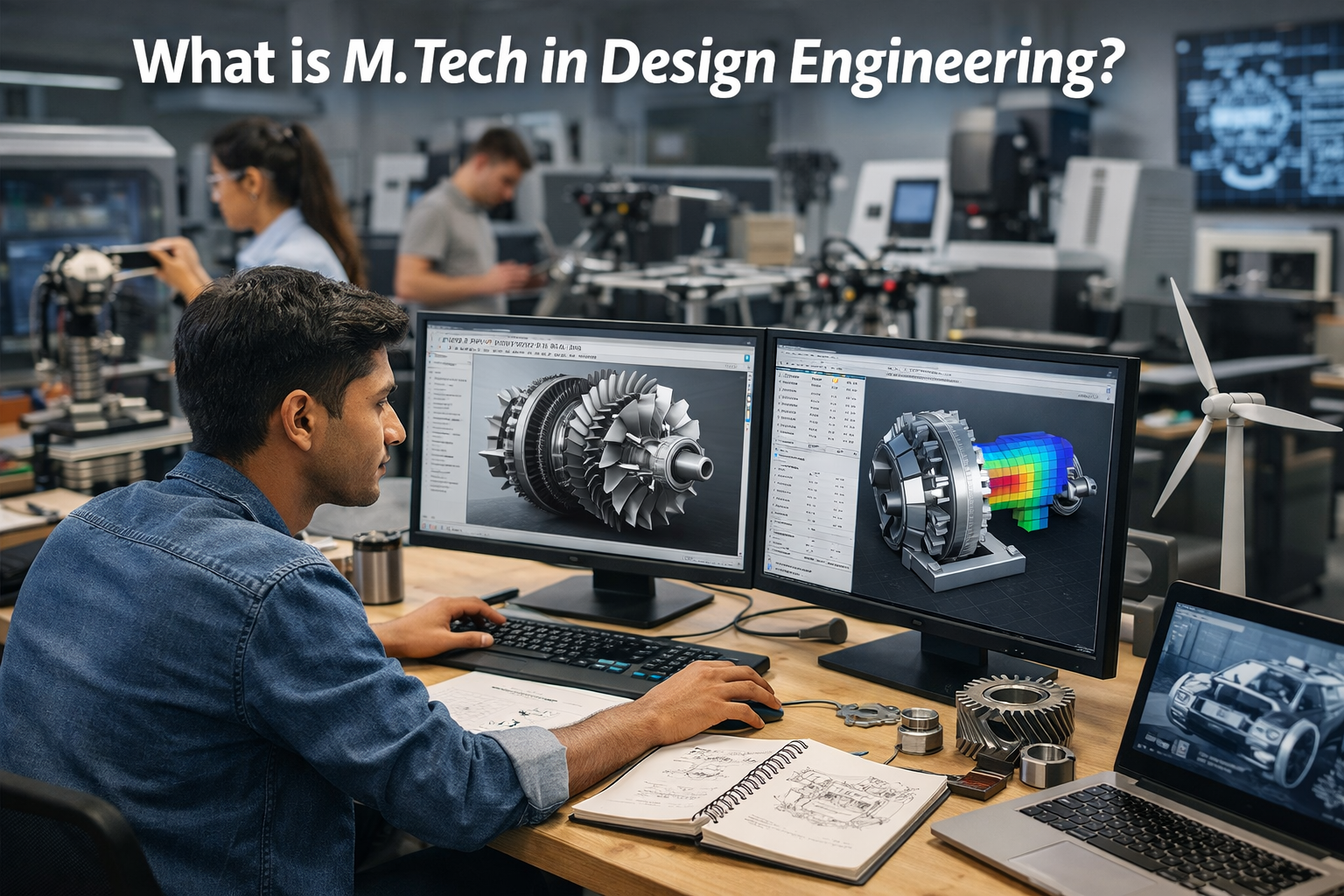 M.Tech in Design Engineering is a specialised postgraduate program that focuses on advanced concepts of designing, analysing, optimising, and improving engineering systems and products. It is designed for students who want to move beyond basic engineering knowledge and develop expertise in creating innovative and efficient solutions for real-world challenges.
This program bridges the gap between theoretical engineering concepts and practical implementation, enabling students to work on complex design problems across industries such as automotive, aerospace, manufacturing, and product development.
It combines a strong foundation of engineering principles with modern tools and technologies, including:
👉 In simple words, this course trains you to design, analyse, and develop real-world products efficiently, creatively, and innovatively, making you industry-ready for high-demand engineering roles.
🚀 Why choose M.Tech in design engineering?
Design Engineering is one of the most dynamic and future-oriented fields in engineering, combining creativity with technical expertise. It allows professionals to work on innovative ideas, develop new products, and improve existing systems that directly impact industries and everyday life.
In today’s fast-changing technological landscape, companies are constantly looking for skilled design engineers who can create efficient, sustainable, and high-performance solutions. This makes design engineering not only a stable career option but also a highly rewarding one.
👉 If you enjoy building, designing, and innovating, Design Engineering can be the perfect career path for long-term success and growth.
The M.Tech in Design Engineering program is carefully structured to provide a balance between theoretical knowledge and practical application. The curriculum is designed to help students understand core design concepts while also developing hands-on experience with modern tools and technologies used in the industry.
The course typically spans over two years and includes classroom learning, lab work, design projects, and research-based assignments. This combination ensures that students are not only academically strong but also industry-ready.
👉 This practical exposure ensures students gain real-world experience before entering the job market.
By the end of the course, students can:
👉 In short, the course prepares you to become a skilled design engineer ready for modern industry challenges.
This course helps you build both technical and analytical skills.
👉 These skills make you highly valuable in the job market.
Design Engineering is the backbone of the manufacturing and tech industry. It involves learning about Machine Design, Finite Element Analysis (FEA), Computer-Aided Design (CAD), and Robotics. In 2026, the curriculum also heavily integrates AI and Machine Learning for predictive design and structural optimisation.
The fee structure varies significantly based on the type of institution you choose.
Top Government Institutes (IITs/NITs). The fees range from ₹50,000 to ₹2.5 Lakhs for the entire two-year program. These institutes are highly subsidised and offer the best ROI.
Top Private Universities (BITS Pilani, VIT, SRM) Fees in premium private institutions generally range from ₹4 Lakhs to ₹10 Lakhs. These colleges often provide state-of-the-art labs and direct industry tie-ups.
State Government Colleges. These are very affordable, with fees ranging between ₹1 Lakh and ₹2 Lakhs for the complete course.
Placement opportunities for Design Engineers are excellent in 2026, especially with the growth of the Electric Vehicle (EV) and Aerospace sectors in India.
Top Recruiter,s Major players include Tata Motors, Mahindra & Mahindra, L&T, Airbus, GE Aviation, Tesla India, and Boeing.
Average Salary Package For graduates from top-tier colleges like IITs, the average package ranges from ₹12 LPA to ₹22 LPA. In private and mid-tier colleges, the average package stays between ₹6 LPA and ₹10 LPA.
Highest Salary Package Specialists in areas like Computational Fluid Dynamics (CFD) or EV Powertrain Design can command packages as high as ₹35 Lakhs to ₹50 Lakhs in premium roles.
Design Engineering is no longer limited to just "drawing." In the current market, you will work on:
Generative Design: Using AI to create thousands of design possibilities.
Electric Vehicles: Designing lightweight structures and battery enclosures.
Sustainable Materials: Working with composites and 3D-printed metal parts.
Pursuing an M.Tech in Design Engineering ensures a career that is both intellectually
👉 Strong academic performance increases your chances of being accepted into top colleges.
Students can choose specialised areas based on their interests.
👉 Specialisation helps you target specific industries.
Understanding the total cost of pursuing an M.Tech in Design Engineering is essential for planning your education effectively. The overall expense includes not only tuition fees but also living costs, study materials, and other miscellaneous expenses.
The cost may vary depending on whether you choose a government institution or a private university, as well as the location and facilities offered.
👉 Government institutions are generally more affordable and offer better ROI, while private colleges may provide advanced infrastructure and facilities.
Apart from tuition fees, students also need to consider monthly living costs.
👉 The total monthly living cost can range between ₹10,000 – ₹25,000, depending on the city and lifestyle.
👉 These additional costs are important for practical learning and skill development.
Many universities and government bodies offer financial assistance to students.
👉 Scholarships can significantly reduce the financial burden.
While the initial cost may seem high, the return on investment (ROI) is strong due to:
👉 In simple terms, investing in this degree can lead to stable and rewarding career outcomes.
An M.Tech in Design Engineering opens the door to a wide range of career opportunities across multiple high-growth industries. As companies continue to focus on innovation, product development, and efficiency, the demand for skilled design engineers is steadily increasing.
This field not only offers diverse job roles but also provides strong earning potential and long-term career growth.
Graduates can explore various roles depending on their skills and specialisation:
👉 These roles are available in industries like automotive, aerospace, manufacturing, robotics, and consumer goods.
Salary depends on skills, experience, and the company you work for.
👉 Candidates with strong technical skills and software expertise often earn higher salaries.
👉 Many multinational companies actively hire design engineers for global roles.
With experience and skill development, professionals can grow into:
👉 This field offers continuous growth with opportunities to move into leadership and innovation roles.
The future of Design Engineering is highly promising, driven by rapid technological advancements and increasing demand for innovation across industries. As companies focus more on efficiency, automation, and smart solutions, skilled design engineers will continue to play a crucial role in shaping the future.
👉 The future belongs to engineers who can combine technology, creativity, and innovation to solve real-world problems and build next-generation products.
Ready to turn your passion for design into a successful engineering career? Connect with our expert mentors today and get personalised guidance on choosing the right M.Tech in Design Engineering program. From college selection to admission support and career planning, we help you at every step. Don’t wait,t ake the first step toward innovation, growth, and a high-paying future in design engineering today! 🚀
M.Tech in Design Engineering is more than just an academic qualification; it is a pathway to innovation, creativity, and a high-growth engineering career. With the right blend of technical knowledge, practical skills, and industry exposure, this program prepares you to solve real-world challenges and build impactful solutions.
As industries continue to evolve with advanced technologies, the demand for skilled design engineers will only increase. Choosing this path means investing in a future filled with opportunities, growth, and global career prospects.
Yes, it offers strong career opportunities in design, R&D, and product development.
It ranges from ₹4 LPA to ₹15+ LPA depending on experience.
GATE is the most common entrance exam.